Wednesday, May 30, 2012

Meter


Definition:

The arrangement of words in regularly rhythmic or patterned lines or verses.

Example:


iambic pentameter (5 iambs, 10 syllables)
  • That time | of year | thou mayst | in me | behold
trochaic tetrameter (4 trochees, 8 syllables)
  • Tell me | not in | mournful | numbers
anapestic trimeter (3 anapests, 9 syllables)
  • And the sound | of a voice | that is still
dactylic hexameter (6 dactyls, 17 syllables; a trochee replaces the last dactyl)
  • This is the | forest pri | meval, the | murmuring | pine and the | hemlock

Significance:

Meter provides rhythmic meaning to a poem. Most neglect the actual beat and arrangement of beats in a poem because they are so focused on the meaning. Meter is always something to notice in poetry.

Rhythm

Definition:

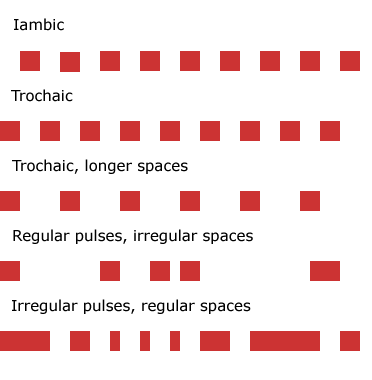
Repetitive beat or pattern of beats in speech or sound.

Example:

Well I gotta go now.
Okay, see you later.
Sure, pal. So long.
See you. Take care.
Bye bye.
Bye bye.


This poem has an obvious rhythm by the number of syllables in each line. When you read it aloud, a pattern of the sound is created.

Significance:

Rhythm, like rhyming, is very important in poetry. It creates a feel for how the poem's meaning should be interpreted. Because poetry does not always include images, sound is the next best thing for finding meaning.

Thursday, May 24, 2012

Onomatopoeia

Definition:

Using a word to display a type of sound.

Example:

"Boom!" "Bang!" "Honk!" "Ding-dong!"

Significance:

An onomatopoeia is significant to literature, poetry in particular, because you  receive the exact idea of sound that the author was trying to display. This way, it is easier to understand.


Personification

Definition:

Giving human emotions, feelings, qualities, and/or senses of character to an inanimate object or something that doesn't show these attributes naturally.

Example:

The stars danced playfully in the moonlit sky. 


You are able to sense personification since you know that stars are inanimate and do not literally dance across the sky.


Significance:

Personification is important to literature because by giving inanimate objects human-like qualities, deeper more accurate portrayal is possible.


Imagery

Definition:

A figurative description of something; using words to create a vivid example of something. Types of imagery include auditory (ears), gustatory (taste), visual (sight), tactile (touch), olfactory (smell). 

Example: 
I took a walk around the world to
Ease my troubled mind
I left my
 body laying somewhere
In the
 sands of time
I watched the world float to the dark
Side of the moon

I feel there is nothing I can do
--"Kryptonite" by Three Doors Down
It is shown that this person is tired and hopeless without actually saying that one is tired and hopeless.

Significance:

Imagery is important because this replaces just simply saying a statement. You can use words to describe settings and emotions that portray the same message that one is trying to get across.


Simile

Definition:

A type of figurative language using "like" or "as" to compare two or more things.

Example:

Becky was as quick as a fox.


Significance:


Similes are important to literature because it uses creativity to compare things. These creates clearer meaning for the things you are trying to compare.

Friday, May 18, 2012

Repetition

Definition:

The act of repeating.

Example:

(excerpt from Rudyard Kipling's "If")


"If you can dream---and not make dreams your master;
If you can think---and not make thoughts your aim,
If you can meet with Triumph and Disaster
And treat those two impostors just the same:."


From this excerpt, you can see the repetition of the phrase "If you can..." The repetition creates a mood to the poem, that the phrase has some significance in the poem's message.

Significance:

The significance of repetition is poetry is the certain mood that it creates for the reader. It shows what is important in the poem, for it is repeated, and that shows significance.


Tone

Definition:


The tone in poetry is the way in which the poem is particularly sounding, whether it has to do with the words that are being said or the modulation within the words.

Example:

(excerpt from Rudyard Kipling's "If")


"If you can keep your head when all about you
Are losing theirs and blaming it on you;
If you can trust yourself when all men doubt you,
But make allowance for their doubting too:"


The tone from this excerpt is very inspiring and uplifting, from the rhythm of the rhyming to the words that are being said.

Significance:

The tone in a poem is significant because it creates a feeling for all reading it. Through a tone, the author can portray the exact message he or she is trying to explain.


Interpretation

Definition:


An explanation of the meaning and/or message of another person's artistic or creative work.


Example:

 (excerpt from Rudyard Kipling's "If")


"If you can make one heap of all your winnings
And risk it on one turn of pitch-and-toss"


My interpretation of this excerpt is that the speaker is trying to tell us that you should live a life full of risks and not be afraid to risk everything that you have, for the reward may be great.


Significance:


Interpretations in poetry are extremely necessary because this allows every reader to take their own unique message or lesson from the same poem. This allows unlimited imagination from both the author and the reader.


Wednesday, May 16, 2012

Metaphor & Extended Metaphor

Metaphor

Definition: 

A type of figurative language in which a phrase is applied to something to which it is not literally meant, but just to suggest resemblance. Used to compare.

Example: 

Her home was a prison.
This implicates that her home was prison like, not that her home was an actual prison.

Significance:

Metaphors are extremely significant in poetry because they add meaning and depth to simple statements by using literal meanings.
Extended Metaphor

Definition:

A metaphor that extends for longer than one sentence. Used to compare.


Example:

All the world's a stage,
And all the men and women merely 
players
They have their exits and their entrances.

-William Shakespeare

Significance:

Extended metaphors are important because they create depth for more than just one sentence. This is extremely helpful in stories and poems because it can create a very clear meaning from what the author is trying to display.


Tuesday, May 15, 2012

Speaker

Definition:


A speaker in poetry is the point of view from which the poem is being told. Sometimes the speaker is the poet, but most often it is a character portrayed to create a certain tone for the poem.


Example:


Pretty women wonder where my secret lies.
I'm not cute or built to suit a fashion model's size
But when I start to tell them, 
They think I'm telling lies.
I say,
It's in the reach of my arms
The span of my hips,
The stride of my step,
The curl of my lips.
I'm a woman
Phenomenally.
Phenomenal woman, 
That's me.


-Maya Angelou


The speaker in this poem may be the author, but it doesn't specify. However you can determine that the speaker is a strong woman who is confident about themselves no matter what anybody else says.


Significance:


The significance of having a speaker in a poem is great because speakers create the mood and tone of of a poem, in addition to proving a strong point of view from which the poem is being told. The tone and point of view are extremely important parts in poetry so that a poem's message is portrayed correctly.


Thursday, May 10, 2012

Symbols

Definition:


A symbol in poetry is a word or phrase that has a literal meaning different than that of the metaphorical meaning that is intended for readers to distinguish.


Example:

Time is money:
This is symbolic because it warns you that when you spend your time, you are giving up the opportunity to be doing something else with that time (just as when you speed your money, you give up your chance to do something else with the money). Furthermore, like money, time is not infinite.

Significance:


Symbols are extremely beneficial in poetry because they create deeper meanings to subjects expressed in the poem. Authors can use metaphors to tell a more distinct story and create more feeling towards their words.


Couplets

Definition: 


A couplet is a pair of consecutive lines that rhyme and are usually the same length.


Example:


"How like Eve's apple doth thy beauty grow,
If thy sweet virtue answer not thy show!"


-Shakespeare


Significance:


Couplets are important to poetry because they group lines in a way that creates a certain meter for a poem. Using couplets is a stylistic way of arranging poetry.


Stanzas

Definition:


A stanza is what is seen as a paragraph in poetry; it is arranged by a specific number of lines and has a certain rhythm, format, and sometimes, a rhyming sequence.


Example:

I Love To Write Poems
(First Stanza)
I love to write
Day and night 
What would my heart do
But cry, sigh and blue
If I could not write
(Second Stanza)
Writing feels good
And I know it should
Who could have knew
That what I do
Is write, write, write.


-Unknown Author


Significance:


Stanzas are extremely important in poetry because they break up a poem into certain ideas, and this then creates the mood for the poem.